Marking the First Wrong Step
One sub-skill card runs at every grade from 4 to 7. It hands a child a finished answer with one wrong line in it. Two of its three levels never change their name; the third changes once.
For teachers · Published 2026-09-27
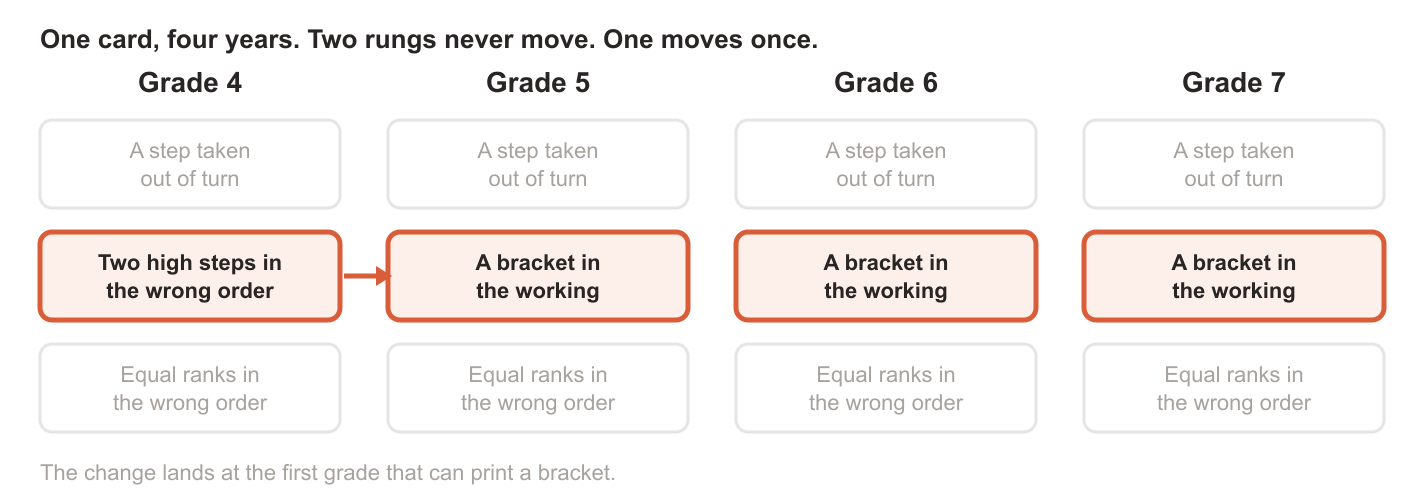
This card does not ask a child for an answer. It hands them somebody else's working, already finished and already wrong, and asks which line went wrong first — which means you are marking a line number, not an arithmetic slip.
What the card asks for
The card is called "Find the first wrong step (HOTQ)", and it runs at all four grades from 4 to 7. Every question prints an expression, then somebody's worked answer to it, step by step. Every one of those lines adds up correctly. Exactly one of them was taken in the wrong order, and the child writes its number and the step that belonged there. The answer is not the final number. It tells you which step went wrong and what the correct step should have been. For example: Step 2, 14 − 4 = 10. That is what the answer key records. Each level tests a different type of mistake. If a child does well on one level but struggles with another, it can give you a clue about which rule needs more practice.: a child who is steady on one level and falls apart on another has told you which rule is missing, because you chose which rule the level would test.
Level 1: A step taken out of turn
A Grade 4 sheet prints: 2 × 7 − 4 + 8, worked as Step 1: 2 × 7 = 14, Step 2: 4 + 8 = 12, Step 3: 14 − 12 = 2.
- Step 1 is correct. Multiplication comes before addition and subtraction, so 2 × 7 = 14.
- Step 2 is the first wrong step. After 2 × 7 = 14, the next step should be 14 − 4. The working jumps to 4 + 8 instead.
Show step 3
The correct next step is 14 − 4 = 10. So the child writes: "Step 2, 14 − 4 = 10."Show step 4
The calculations are correct on their own. The mistake is the order in which the steps were done. That is why simply checking the arithmetic does not find the mistake.
Answer: Step 2, 14 − 4 = 10
Level 3: Equal ranks in the wrong order
A Grade 4 sheet prints: 4 + 8 − 5 + 2, worked as Step 1: 4 + 8 = 12, Step 2: 5 + 2 = 7, Step 3: 12 − 7 = 5.
- There is no multiplication here at all. Every operation is an addition or a subtraction, so every one of them has the same rank.
- That is what Level 3 tests. When addition and subtraction have the same priority, work from left to right. This working breaks that rule at Step 2 by doing 5 + 2 before 12 − 5.
Show step 3
So the answer is "Step 2, 12 − 5 = 7".Show step 4
If a child gets Level 1 right but struggles with Level 3, they may understand which operations come first but need more practice with the left-to-right rule.
Answer: Step 2, 12 − 5 = 7
What moves between Grade 4 and Grade 7, and what does not
Two of the three levels keep the same name from Grade 4 to Grade 7: "A step taken out of turn" and "Equal ranks in the wrong order". The middle level changes once. At Grade 4 it is "Two high steps in the wrong order". From Grade 5 onward it is "A bracket in the working". It moves there because Grade 4 cannot print a bracket. Brackets arrive with Grade 5 — three of its six sub-skill sheets are named for them, and brackets turn up on more than those three — so the middle rung can be about a bracket taken out of turn, which is a third mistake rather than a new home for the first two. A Grade 5 question looks like (8 + 3) × 2 + 8 worked as Step 1: 3 × 2 = 6, and the answer is "Step 1, 8 + 3 = 11". The second thing that moves is the shape of the working, and it moves at a different grade. Grades 4 and 5 print three steps. From Grade 6 they print four, because the expression gains an operand: 8 × 7 − 12 ÷ 2 − 5, worked in four lines. That is one more place for the wrong line to be. Grade 7 keeps Grade 6's eight sheets and its four steps, and changes the numbers rather than the shape: it draws from a wider range, so a line can carry a 13 or a 15 where Grade 4 stops at 8. Two levers, two grades. The names move at Grade 5 and the shape moves at Grade 6, and the skill the card is asking for — read somebody else's order and find where it first broke — is the same in all four years.
Grade 5 · Find the first wrong step (HOTQ)
Level 1: A step taken out of turn · 12 questions
"Find the first wrong step (HOTQ)" at Grade 5, level 1. Print it, then print level 3 of the same card. The two sheets plant different mistakes on purpose, so the pair tells you whether a child is missing the ranking or the tie-break — which one sheet on its own cannot.
Open this worksheet/worksheets/grade-5/order-of-operations/first-wrong-step/
Open this worksheet: www.kidoslab.com/worksheets/grade-5/order-of-operations/first-wrong-step/?d=1&n=12
Check what you are looking at
1. A child hands back this card with a column of numbers as their answers. What has gone wrong before you mark any of it?
Show answer
They answered the expression instead of the question. The card asks for a line number and the step that belonged there — "Step 2, 14 − 4 = 10" — and the instruction line on the sheet gives that format in full.Answer: They answered the expression instead of the question. The card asks for a line number and the step that belonged there — "Step 2, 14 − 4 = 10" — and the instruction line on the sheet gives that format in full.
2. A child is reliable on Level 1 but struggles with Level 3. Which rule might need more practice?
Show answer
The left-to-right rule. Level 3 tests what happens when addition and subtraction have the same priority.Answer: The left-to-right rule. Level 3 tests what happens when addition and subtraction have the same priority.
3. A Grade 6 sheet of this card prints four steps where Grade 4 printed three. How many operands is the expression carrying?
Show answer
Five. The printed steps are always one fewer than the operands, so four steps means five numbers in the line.Answer: Five. The printed steps are always one fewer than the operands, so four steps means five numbers in the line.
Questions parents ask
- Where do I find this card?
- On the topic page for any of Grades 4 to 7, listed as "Find the first wrong step (HOTQ)". The acronym is this site's own shorthand and is not used anywhere else on it.
- What is on the answer key?
- The number of the wrong line and the step that belonged there, in the same form the sheet's instruction line shows, for example "Step 2, 6 × 4 = 24". Not the value of the expression.
Was this guide helpful?