Situation guideAny grade
How to Break Big School Tasks Into Smaller, Easier Steps
A project due in two weeks can easily become a project due tomorrow. A two-week plan shown day by day, planning backwards from the deadline, a spare day for the step that runs late, and how to check in without taking over.
When a big task keeps waiting
A project due in two weeks has a way of becoming a project due tomorrow. Parents and teachers can help a student stop that happening by turning one big task into small steps, each with its own date.
Due in two weeks, started the night before
Big tasks wait because there is no obvious first step, and because they look shorter from a distance than they really are. Take an eleven-year-old with a science project on how plants grow, set on a Monday and due two weeks later.
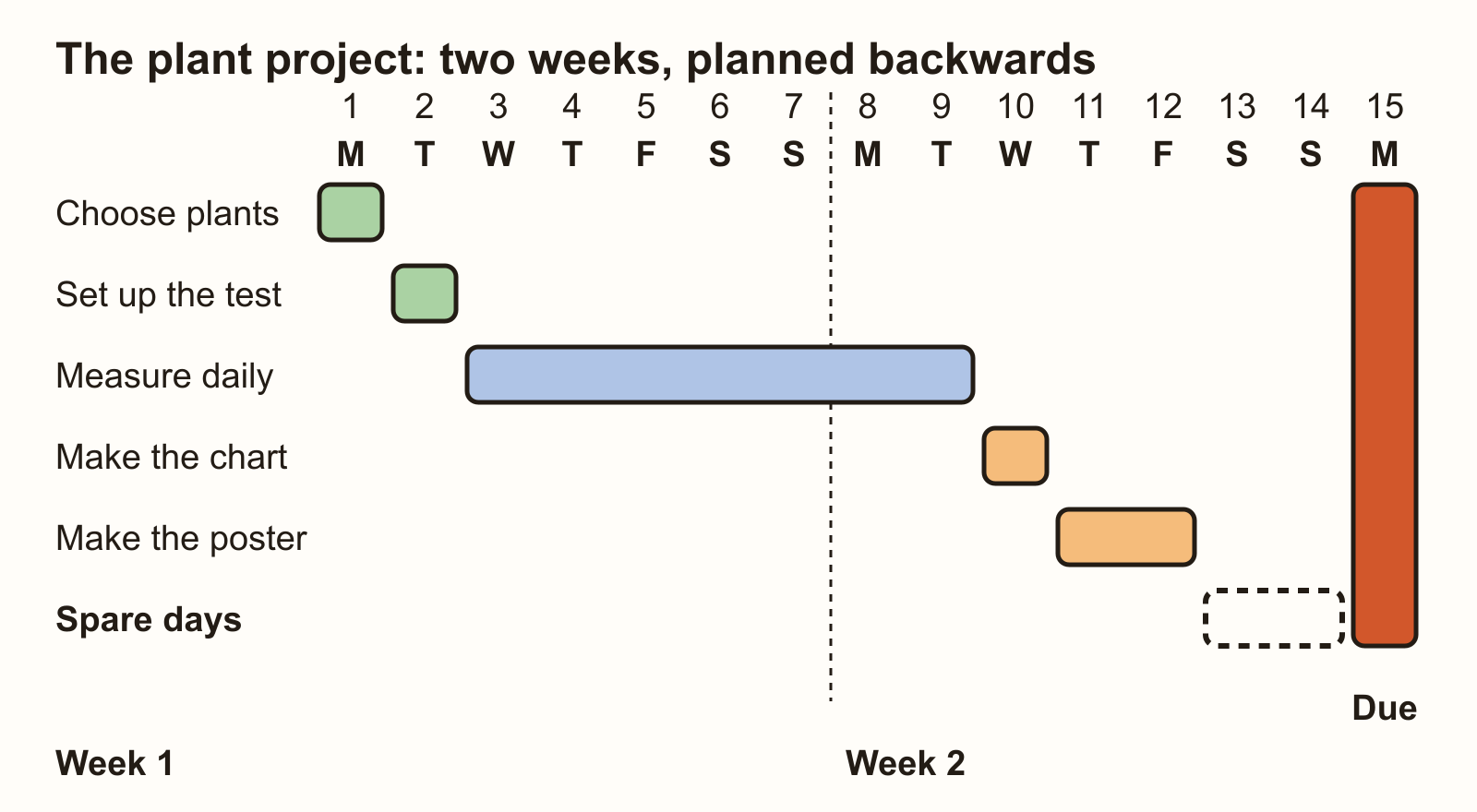
The plant project, day by day
A science project on how plants grow, set on Monday (day 1) and due two Mondays later. It needs a question, an experiment, results and a poster.
- Day 1, Monday: read the task sheet together and list everything it asks for. Choose two plants and the question.
- Day 2, Tuesday: set up the test, with one pot in the light and one in a cupboard.
- Days 3 to 9: measure both plants every day and write the heights in a table. Two minutes a day.
- Day 10, Wednesday: turn the table into a chart.
- Days 11 and 12, Thursday and Friday: make the poster.
- Days 13 and 14, the weekend: spare, for the step that runs late. The project goes in on Monday.
Answer: Six small dated steps instead of one big one, with two spare days before the deadline.
Plan backwards from the due date
Write the due date at the end of the calendar first. Then place each step working backwards: the poster just before the deadline, the chart before that, the measuring before that. If the steps do not fit, you find out on day 1, not day 14.
Give every step a verb and a date
"Poster" is a topic. "Write the poster's title and headings" is a step. Each step starts with a verb, has a date, and fits into one sitting.
Keep a spare day
Estimate each step, then add a little. A plan with no slack falls over at the first late night or sick day, and the spare day is what catches it.
Check in without taking over
Every second day, look at the list together for two minutes and ask which step comes next. Help with the plan, but leave the work to the student.
If the big task is yours
If you are a student with a big task, try this tonight. Write the due date at the top of a page, list every part of the task, and give each part its own day, working back from the end. Leave a spare day. Then do just the first step.
If the plan keeps slipping
Plans slip, and that is normal. Move the remaining steps and protect the spare days. If the task sheet is unclear, the student should ask the teacher rather than guess.
If a project cannot be finished in time even with a plan, tell the teacher early, not on the due date. And if planning stays very hard across every subject, raise it with the school.
Tonight, sit down with the task sheet and write two things: the due date, and the first step with tomorrow's date next to it.
Questions parents ask
Should the plan be on paper or on a phone?
Either works, as long as the student sees it every day. A paper list on the fridge is easy for the whole family to glance at, while a phone calendar can send reminders.
Was this guide helpful?