Choosing a grade level that is not the school's
A step-by-step way to pick a worksheet grade when it does not match the year your child is in at school, using what each level actually generates rather than the number on the tab.
For parents and teachers
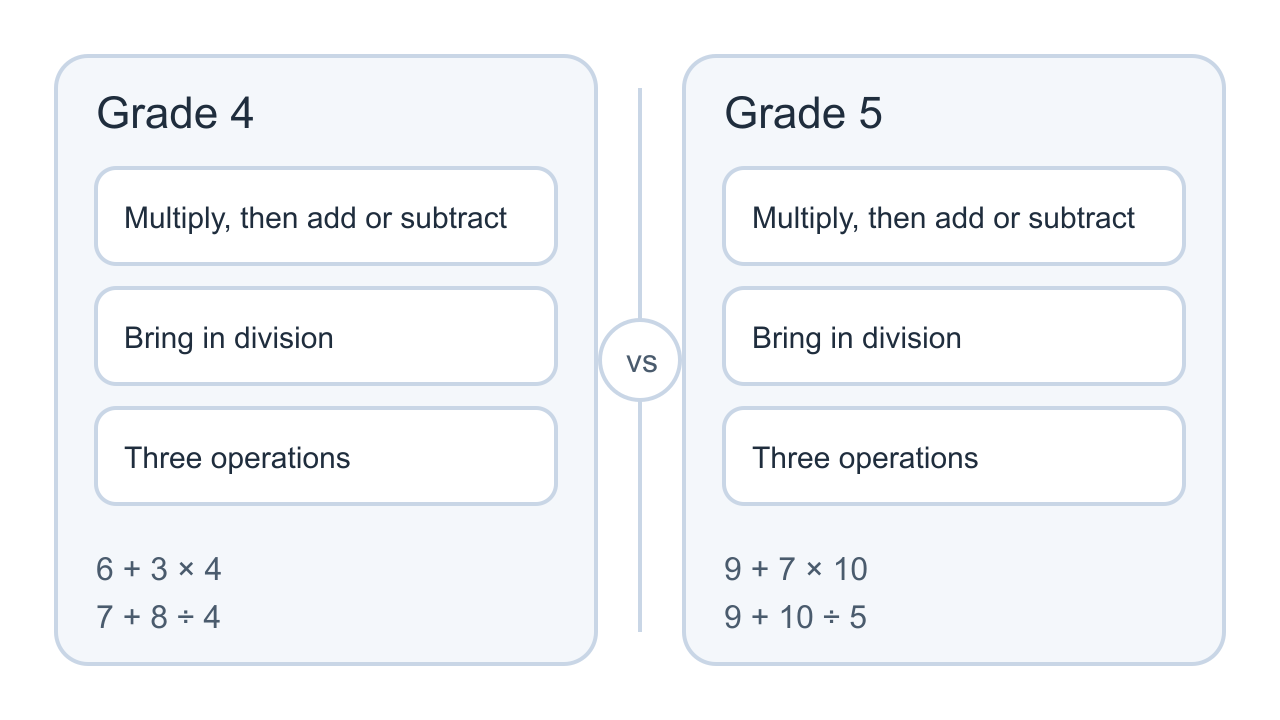
Your child is in one year at school, and the sheet that suits them is filed under a different grade. Printing the one with the matching number gives you twenty problems they finish in four minutes. Printing the one that looks right gives you twenty they cannot start. Neither tells you much, and both cost you an evening.
The number is a shelf, not a measurement
A grade on this site is a place to file a sheet. It says which concept the sheet is built around, not how hard any particular sheet is. Two pages a grade apart can carry the same sub-skill, and the three levels on each move only inside their own page. So two things are true at once: your child's school year is a fact about your child, and the grade tab is a fact about the sheet. Lining them up is a choice, and it is yours to make. That choice is easier here than it looks, because every level says what it generates before you print it. You are not being asked to guess whether "Grade 5" is right. You are being asked to read three short labels and decide which one describes work your child can do today.
The same sub-skill can sit on four grades at once
Here is the part that catches people out, and it is specific to how this catalogue is built. A sub-skill is not owned by one grade. Two-operation chains appear on four different grade pages, and on every one of them the three levels carry word-for-word the same labels. The label does not move; what the generator is allowed to put in the problems does. So a parent comparing two grade pages side by side will often see identical level names and conclude the pages are identical. They are not. The grade decides the ingredients, and the level decides how many of them arrive at once. This is why the grade number and the level label together still do not tell you what lands on the sheet, and why the only reliable move is to open the page and read what the level produces.
Working it out, one question at a time
1. Have you opened the grade page that your child's school year points at, and read what its three levels generate?
Yes: go to question 2
No: Start there, and read the levels rather than the tab. Two minutes on that page settles most of this, and it costs nothing to look before you print.
2. On that page, can your child finish the first level on their own?
Yes: go to question 3
No: Stay on that grade and print the first level. A sheet that gets finished is worth more than a sheet with the right number on it, and finishing is what makes the next one possible.
3. Can they also finish the third level on that same page without help?
Yes: go to question 4
No: You are already on the right grade. Move the difficulty up a step instead of moving the grade up: that is exactly the range the three levels exist to cover.
4. Does the next grade up carry a sub-skill with the same name?
Yes: Open both and compare what the levels generate, not what they are called. The names are frequently identical across grades; the problems behind them are not.
No: go to question 5
5. Is there a differently named sub-skill on that next grade covering the same idea?
Yes: Print its first level as a trial sheet and watch what happens. One short sheet usually settles it faster than another round of comparing grade numbers.
No: Stay where you are and use the higher difficulty. A grade with nothing matching on it is not the next step for this child, whatever its number suggests.
Grade 5 · Two Operations
Level 1: Multiply, then add or subtract · 12 questions
A short trial sheet is the fastest way to test a grade choice. Print the first level here, watch whether the first two problems start without help, and you have your answer in one sheet rather than one evening.
Open this worksheet/worksheets/grade-5/order-of-operations/two-operations/
Open this worksheet: www.kidoslab.com/worksheets/grade-5/order-of-operations/two-operations/?d=1&n=12
What a trial sheet tells you
Print a short one. Twelve problems is plenty; you are testing a decision, not running a lesson. Watch the first two problems only, because that is usually where a level being wrong shows up. If your child starts without asking you anything, the level is probably right, or a little easy. If they read the first problem twice and then look up, it is a step too high, and the fix is the difficulty control on the same page rather than a different grade. One more thing worth knowing before you print: each of these sheets comes with its own answer key, so you can hand it over and check it afterwards without sitting through it.
Check your own choice
1. You picked a grade because it matches the year your child is in at school. What have you not checked yet?
Show answer
What the levels on that page actually generate. The year is a fact about your child; the tab is a filing decision about the sheet. Only one of them describes the problems.Answer: What the levels on that page actually generate. The year is a fact about your child; the tab is a filing decision about the sheet. Only one of them describes the problems.
2. Two grade pages show the same sub-skill with the same three level labels. Are the sheets the same?
Show answer
No. The labels can be identical while the grade changes what the generator may put into a problem. Read what each level produces rather than trusting matching names.Answer: No. The labels can be identical while the grade changes what the generator may put into a problem. Read what each level produces rather than trusting matching names.
3. Your child finishes the first level easily but stalls halfway through the third on the same page. What should move?
Show answer
Nothing about the grade. That is the span the three levels are built to cover, so settle on the middle one and stay where you are.Answer: Nothing about the grade. That is the span the three levels are built to cover, so settle on the middle one and stay where you are.
Questions parents ask
- Should I tell my child which grade the sheet came from?
- Only if they ask. The number says where the sheet is filed, not how your child is doing, and it is worth saying so plainly if it comes up.
- My child is comfortably ahead of their school year. Do I just move up a grade?
- Move up a level first and see what happens, because the three levels on one page already cover a wide span. Move the grade when the third level on the current page is finished without help.
Was this guide helpful?