Situation guideAny grade
When You Don't Understand the Way Your Child Is Being Taught Math
When your child's math homework looks nothing like the way you learned, understand their method before showing another. 58 + 27 worked three ways, letting your child teach you, using your own method as a quiet check, and asking the school.
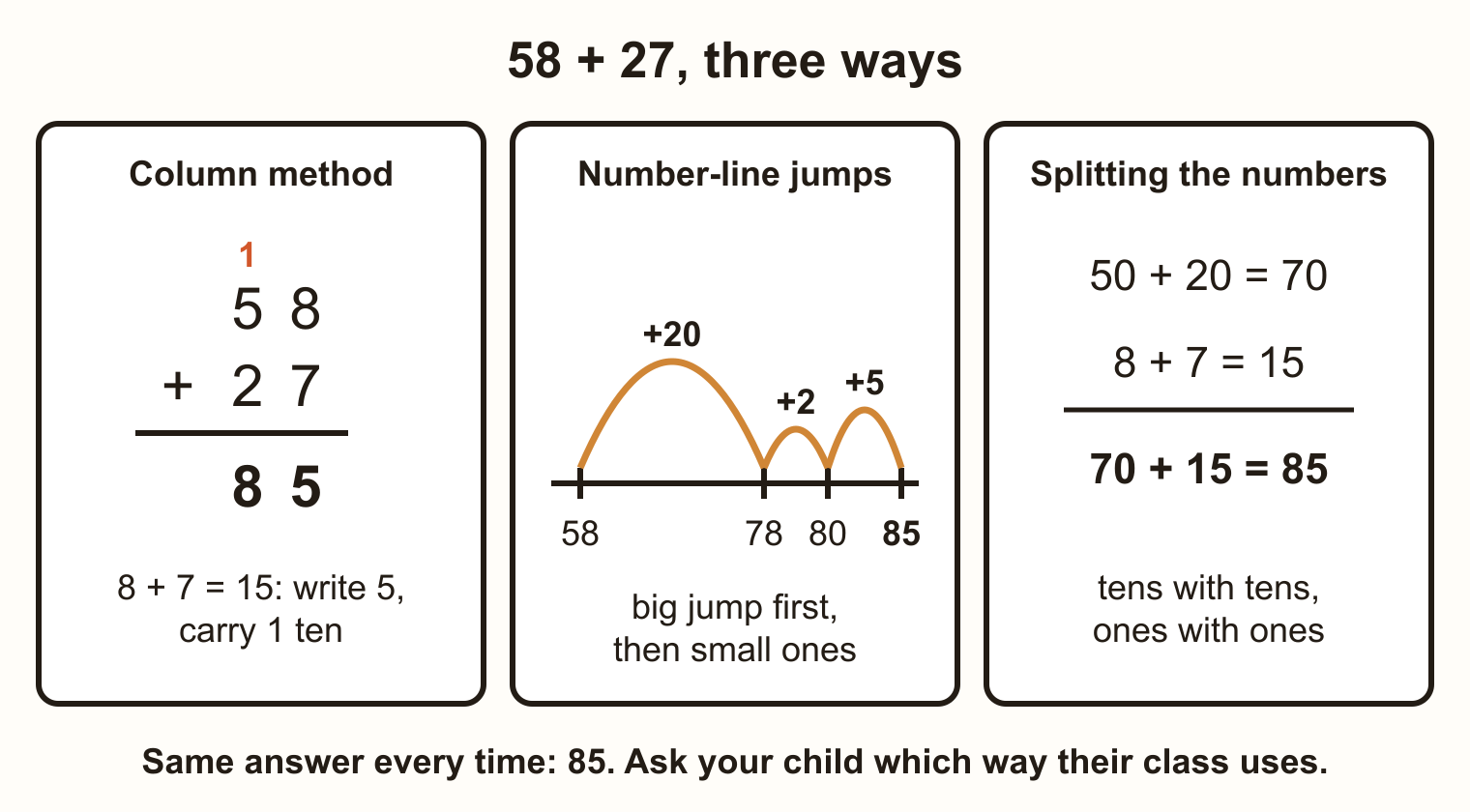
Your nine-year-old's homework shows 58 + 27 as jumps along a line, and it looks nothing like the carrying you learned. You know the answer, but not the method, and showing your own way feels like the obvious fix.
Understand their method first
Before you show another way, understand the one your child is learning. Two methods at once can leave a child unsure which one counts. You do not need to be confident in math for this, because your child can be the teacher.
Schools often teach methods that show how numbers are built, such as splitting into tens and ones or jumping along a number line. The column method has not disappeared. England's national curriculum uses objects, pictures and the number line, and still requires formal written methods such as column addition.
58 + 27, three ways
Add 58 and 27. Three methods your child might meet, all giving the same answer.
- Column method: 8 + 7 = 15, so write 5 and carry 1 into the tens. Then 5 + 2 + 1 = 8 tens, which gives 85.
- Number-line jumps: start at 58, jump 20 to 78, jump 2 to 80, then jump 5 more to 85.
- Splitting the numbers: 50 + 20 = 70 and 8 + 7 = 15. Then 70 + 15 = 85.
Answer: 85 every time. Each method writes down a different part of the same thinking.
Let your child teach you
"Show me how your teacher does it" puts your child in charge, and shows you where they are unsure. If they cannot explain a step yet, look at the class example together, with your child holding the pencil.
Ask rather than correct: "Why did you split the 58 that way?" If the explanation falls apart, that is useful to know, and worth a short note to the teacher.
Use your method as a quiet check
Work the sum your way on a scrap of paper, out of sight, and compare answers. If they match, there is nothing to discuss. If they differ, check your own working first; it may be the one with the slip.
Ask the school for one example
If neither of you can make sense of the method, send a short note asking for one worked example. Name the problem and the step where you both got stuck, so the teacher can answer in a few lines. It is also worth asking whether the school has a written guide to its methods.
If the method still has not clicked after a few weeks, ask the teacher to show you both in person.
Tonight, ask your child to show you how they did one sum from their homework, and let them hold the pencil.
Questions parents ask
Why does my child have to explain their thinking?
Explaining shows understanding, not just steps. It also lets the teacher see exactly where a slip happened.
Was this guide helpful?