Situation guideAny grade
How to Help a Child Who Feels Overwhelmed by a Full Page of Work
Some children stop before the first problem because the whole page looks like too much. Cover the page so one row shows at a time: the work stays the same, and only what is visible changes. Other ways to cut any sheet down, and when to tell the teacher.
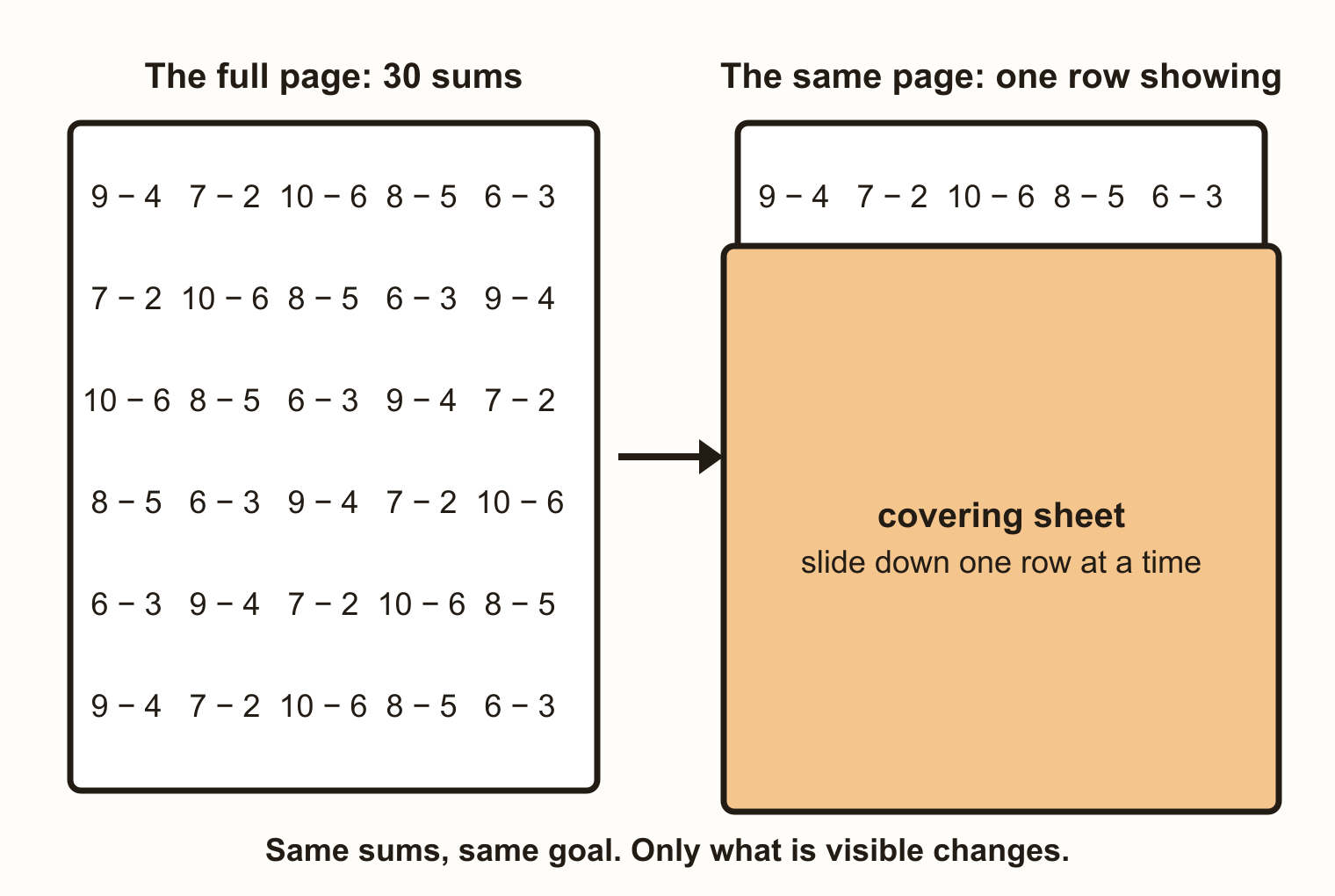
"There's too many," says your six-year-old, looking at a sheet of thirty subtraction sums, and the pencil goes down before the first one. You know most of the answers are within reach.
Cover most of the page
A page that is full from edge to edge can look like a mountain, even when each sum on it is easy. The fix is simple: cover most of the page, so your child sees one row at a time.
The work stays exactly the same. Same sums, same goal; only what is visible changes.
The same thirty sums, one row at a time
A sheet of thirty subtraction sums, pushed away before the first one.
- Fold the page, or cover it with a sheet of paper, so only the first row of five shows.
- Do the first two together if needed, then let your child finish the row alone. Then take a one-minute stretch.
- Open the next row and tick the finished one, so your child can see the done pile growing.
- Next time, print fewer sums per page, and add a row back each time it starts to feel easy.
Answer: The same sums and the same goal, on a page that no longer shouts at your child.
Say the plan out loud
Before starting, say the plan in one line: "First this row, then a stretch, then the next row." For a six-year-old, that is a whole plan, and it shows where the end is.
Smaller pieces from any sheet
You do not need a special worksheet. Cut a school sheet into three strips and hand them over one at a time. Lay a ruler or a folded card under the row being worked on.
The same idea works for a page of reading questions. Cover everything below the question in front of your child, and slide the cover down as each one is done. Keep the covering sheet in the homework folder, so it is ready next time.
When the page is not the problem
If your child still will not start with five sums on view, look elsewhere. The work might be too hard, the time of day might be wrong, or something else might be on their mind. Ask at a calm moment what makes the sheet feel hard, and listen to the whole answer.
Telling the teacher
If most sheets end this way, or it happens at school too, tell the teacher. Ask whether the same work can come in smaller pieces, such as fewer items per page or a sheet cut into strips.
Tonight, before the next full page, fold it so that only the first row shows.
Was this guide helpful?