Situation guideAny grade
Simple Ways to Build a Reading Habit at Home
A reading habit is less about willpower than about where reading sits in the day. Choose a regular time, keep books within reach, start small, allow missed days and make reading part of family life, with a plan for the first two weeks.
Reading that waits for a free evening
In many homes, reading happens only when there is a spare moment, which means it rarely happens at all. Take a six-year-old whose family means to read every night. Bath time runs late, and the book stays on the shelf.
A habit is less about willpower than about where reading sits in the day. Tie it to something that already happens, and it stops needing a decision.
Choose one regular time
Pick a moment that already happens every day: bedtime, breakfast, the bus, or the wait at a sports club. Bedtime suits calm evenings. Breakfast suits families who are rushed at night, and the car suits audiobooks.
Choose one main slot and one spare, so that a missed bedtime does not mean a missed day.
Keep books within reach
Keep books where your child already sits: by the bed, next to the sofa, in the car door. A book in arm's reach is easier to pick up than one on a high shelf. A regular library trip keeps the supply fresh at no cost.
Start small
Five minutes a day is easier to keep going than a long session once a week. Keep it short enough that nobody dreads it, and let it grow only while it stays easy.
The first two weeks
A six-year-old, a bedtime slot, and a family that wants reading to stick.
- Days 1 to 3: five minutes at bedtime, with the book already by the bed. Stop while it is still fun.
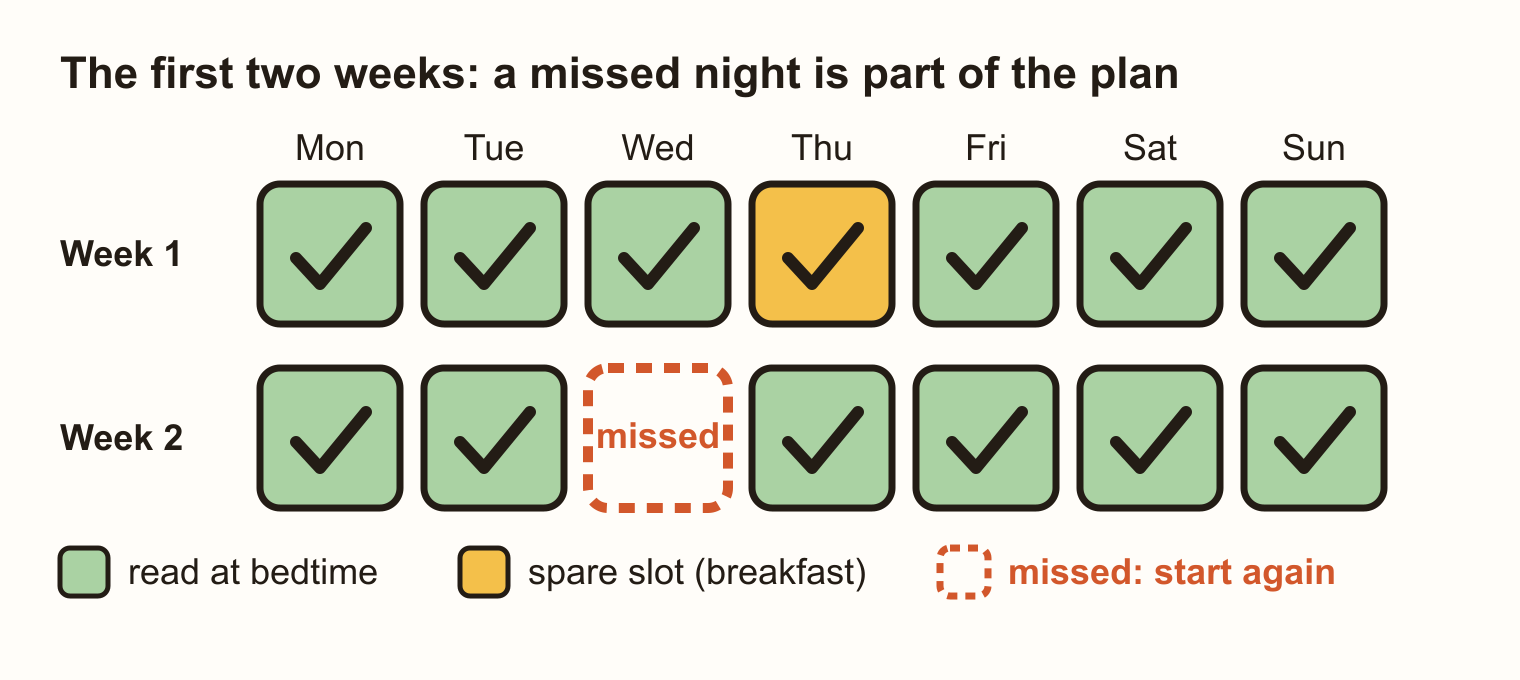
- Day 4: bath time runs late, so use the spare slot instead: two pages over breakfast.
- Days 5 to 7: back to bedtime, still five minutes.
- Week 2: add a few minutes if it stays easy. One evening is missed. Nobody mentions it, and reading starts again the next night.
- End of week 2: a library trip, so there are new books by the bed for week 3.
Answer: Thirteen short reads in fourteen days, and a slot that now happens without anyone deciding.
Allow missed days
A missed night is not a broken habit. Pick it up the next day without comment. Making a fuss turns reading into one more thing to feel bad about.
Holidays, a new term or an illness will knock the slot off course. Plan a smaller version for those weeks, such as one short book at bedtime or an audiobook on a long drive. The habit is the slot coming back, not an unbroken record. If school sends a reading log, fill it in quickly; it is not the reason for reading.
Make it part of family life
Let your child see you read, even a few pages of a newspaper or a recipe. Reading to your child counts too, at any age.
Whatever your rules on screens, give reading a slot of its own. It does better as a fixed part of the day than as the thing that happens when the screen goes off.
If reading time keeps going wrong
If reading time keeps ending in tears, or your child avoids reading aloud to you, raise it with the teacher. Ask whether reading at home should look different for a while: shorter, a different kind of book, or more reading to your child and less by them.
Tonight, put one book where your child sits at bedtime, and read together for five minutes.
Questions parents ask
What if two children need different reading times?
One shared slot can still work. A younger child can be read to while an older one reads alone nearby, each with their own book.
Was this guide helpful?